
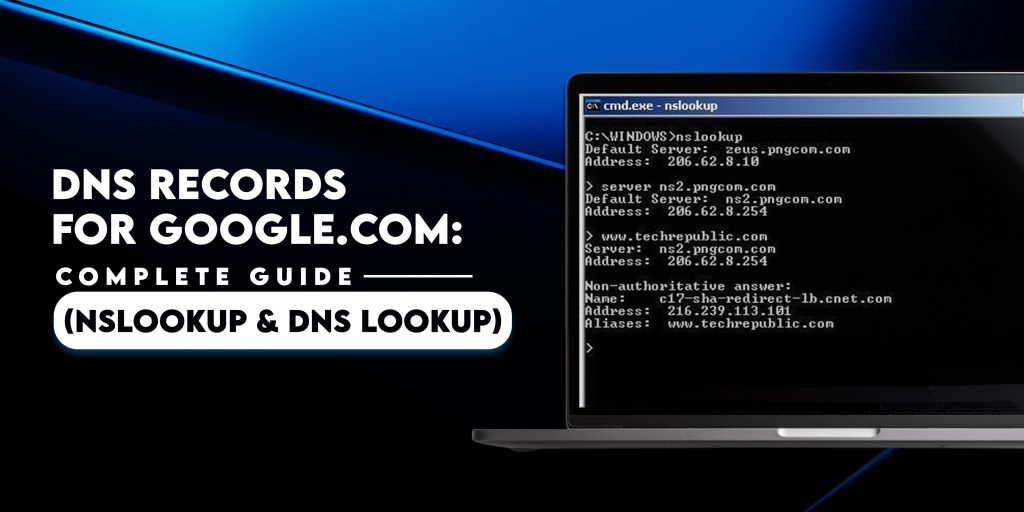
Google.com is one of the most widely used websites in the world, and its DNS infrastructure is designed for speed, reliability, and security. If you want to check DNS records for Google.com or understand how Google DNS works, this complete guide will help you.
In this article, you will learn:
- What DNS records are and why they matter
- How to perform an NSLookup for Google.com
- Details of Google.com A, AAAA, TXT, MX, NS, and SOA records
- Information about Google’s public DNS servers
This guide is useful for developers, system administrators, students, and SEO professionals.
What Are DNS Records?
DNS (Domain Name System) acts as the Internet’s phonebook. When a user types google.com into a browser, DNS records translate that domain name into IP addresses so the browser can connect to the correct server.
Common DNS record types include:
- A Record: Maps a domain to an IPv4 address
- AAAA Record: Maps a domain to an IPv6 address
- MX Record: Defines mail servers for a domain
- TXT Record: Used for verification and security
- NS Record: Identifies authoritative name servers
- SOA Record: Contains administrative DNS information
DNS Records for Google.com
DNS (Domain Name System) is the Internet’s translation layer. For a global entity like Google, DNS isn’t just a phonebook; it’s a load-balancing engine that routes traffic to the nearest data center.
A Record (IPv4 Address)
Google uses Anycast IP routing. When you perform a lookup, you don’t just get one IP; you get the IP of the server closest to your physical location.
Example:
- 216.58.208.110
A records play a key role in website availability, speed, and global load balancing.
AAAA Record (IPv6 Address)
The AAAA record shows the IPv6 address for Google.com, which supports modern networks and improves scalability.
Example:
- 2a00:1450:400e:806::200e
IPv6 helps future-proof Google’s global infrastructure.
MX Records (Mail Exchange)
MX records specify which mail servers are responsible for receiving emails for a domain.
Example:
- smtp.google.com (Priority 10)
These records ensure reliable email delivery for Gmail and Google Workspace.
TXT Records (Verification & Security)
TXT records are used for multiple purposes, including:
- Domain ownership verification
- Email authentication (SPF, DKIM, DMARC)
- Third-party service verification (Google, Microsoft, Apple, Facebook, etc.)
Google.com has multiple TXT records configured to maintain trust and security.
SPF Record for Google
SPF (Sender Policy Framework) records help prevent email spoofing.
Example SPF record:
v=spf1 include:_spf.google.com ~all
This means only authorized Google servers are allowed to send emails on behalf of the domain.
NS Records (Name Servers)
NS records indicate which servers manage the DNS records for a domain.
Google.com name servers:
- ns1.google.com
- ns2.google.com
- ns3.google.com
- ns4.google.com
These are Google’s authoritative name servers.
SOA Record (Start of Authority)
The SOA record contains important administrative details about the DNS zone, including:
- Primary name server
- DNS administrator email
- Serial number
- Refresh, retry, and expire values
The SOA record helps keep DNS data consistent across servers.
How to Check Google DNS Records Using NSLookup
You can check Google.com DNS records using command-line tools or online DNS lookup services.
NSLookup Command Example
nslookup google.com
This command returns basic DNS information such as IP addresses and name servers.
Online DNS Lookup Tools
Online tools allow you to quickly check:
- A and AAAA records
- MX records
- TXT records
- NS and CAA records
No technical setup is required.
Google Public DNS Servers Explained
Google also provides public DNS servers that are widely used for faster and more secure internet browsing.
Google DNS IP addresses:
Primary: 8.8.8.8
Secondary: 8.8.4.4
New for 2026: Google has fully integrated DoH (DNS over HTTPS) and DoT (DNS over TLS) into its public DNS, ensuring that your browsing queries are encrypted and private from ISP eavesdropping.
Benefits of Google DNS
- Fast DNS resolution
- High reliability
- Improved security
New Section: DNSSEC & CAA Records
Add this to outrank competitors who only cover basic records.
The Integrity Layer: DNSSEC
Google.com is signed with DNSSEC (DNS Security Extensions). This adds a digital signature to every record, ensuring that a “Man-in-the-Middle” attacker cannot spoof the IP address and send you to a fake version of Google.
The Certificate Layer: CAA
The CAA (Certificate Authority Authorization) record for Google specifies exactly which Certificate Authorities (like Google Trust Services) are allowed to issue SSL certificates for the domain. This is a critical defense against unauthorized certificate issuance.
Why Google DNS Records Matter
Google’s DNS records are important because they:
- Ensure website uptime and performance
- Support global traffic distribution
- Improve email security and delivery
- Enable secure domain verification
Google’s DNS infrastructure is often considered an industry benchmark.
Frequently Asked Questions (FAQs)
What is the DNS server for Google?
Google’s public DNS servers are 8.8.8.8 and 8.8.4.4.
Why does google.com return different IPs in different countries?
This is due to Geo-DNS and Anycast. Google detects your location and provides the IP of the nearest edge server to reduce “ping” time.
Can I use Google DNS to speed up my gaming?
Yes. By using 8.8.8.8, you often bypass slow ISP DNS resolvers, leading to faster “lookups,” though it doesn’t change your actual bandwidth.
What is Google’s SPF record?
It is v=spf1 include:_spf.google.com ~all. It ensures that only Google’s servers can send emails on behalf of @google.com.
How can I check Google DNS records?
You can use the NSLookup command or an online DNS lookup tool.
Is Google DNS safe to use?
Yes, Google DNS is fast, secure, and trusted worldwide.
What is Google’s SPF record?
Google uses _spf.google.com to define authorized email-sending servers.
Take Control of Your DNS Infrastructure
Google.com’s complex DNS records show exactly how global tech giants maintain 100% uptime and elite security. Understanding these records isn’t just for experts, it’s the key to better troubleshooting, faster loading speeds, and robust email security.
Stop relying on slow command lines. Whether you need to verify a new A Record, check your MX priorities, or audit your SPF/DMARC for email security, HasheTools Advanced DNS Lookup provides everything you need in one click.
Use HasheTools to instantly check:
- Full Record Stack: A, AAAA, MX, TXT, and CNAME records.
- Security Verification: Instant check for SPF, DKIM, and DMARC.
- Global Propagation: See if your DNS changes have reached the world.
- Speed & Accuracy: No-wait results directly from authoritative servers.